

























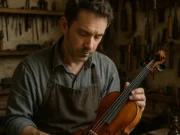



Decoding the Sound of Stradivari: The Secrets Behind Cremonese Violins Revealed – Research & Innovation
## The Enigmatic Sound of Cremonese Violins
For centuries, the musical world has been captivated by the exquisite sound of Cremonese violins crafted by masters such as Antonio Stradivari and Giuseppe Guarneri del Gesù. Made in the bustling violin-making hub of Cremona, Italy, these instruments have undergone relentless scrutiny by musicians and scientists alike, all seeking to uncover the secret behind their unparalleled tonal qualities. Despite advancements in modern instrument-making, replicating the rich and complex sound of these historic violins remains an elusive challenge.
### The Ongoing Debate
The quest to understand what makes Cremonese violins so unique has frustrated experts for over 200 years. Blind listening tests have indicated a preference for Stradivari violins, although the results from live performances have not consistently supported this finding. Such discrepancies highlight the remarkable complexity of the sound produced by these instruments. Many scholars have theorised that the secrets behind their sound lie in lost techniques unique to the Cremonese masters.
While scientists have primarily focused on the shape and varnish of the violins, attempts to mirror these features alone have failed to capture their exceptional sound. At the heart of a violin lies its soundboard, which must be both strong and flexible, capable of withstanding an impressive eight kilograms of tension from the strings. Modern luthiers often increase the thickness of the soundboard compared to their ancient counterparts—typically around 3.0 to 3.5 millimetres versus Stradivari’s thinner boards that measured between 2.0 and 2.8 millimetres. This difference hints at other factors at play, suggesting that it was not merely the choice of wood or craftsmanship, but rather a unique treatment that contributed to the violins’ signature sound.
### Uncovering Chemical Treatment
In a groundbreaking study led by Hwan-Ching Tai, a chemistry professor at National Taiwan University, researchers have taken significant steps towards understanding these unique properties. The team analysed a rare collection of wood samples from Cremonese violin-making dynasties, including Amati, Stradivari, and Guarneri. They compared these samples to modern violin wood and discovered surprising chemical compositions that supported a long-standing theory proposed by Joseph Nagyvary, a biochemistry professor emeritus at Texas A&M University.
Nagyvary suggested nearly 40 years ago that the wood used in these violins underwent aggressive chemical treatments. These treatments were not only intended to enhance sound quality but also to protect the wood from prevalent worm infestations of the time. The recent research confirmed this theory, identifying several chemicals—including borax, zinc, copper, alum, and lime water—used to treat the wood.
### The Blend of Artistry and Science
Borax, for instance, has a rich history as a preservative dating back to ancient Egypt, while its presence here suggests that Cremonese luthiers collaborated with local pharmacists to enhance and protect their materials. Nagyvary emphasises that each maker had their own proprietary process, with the unique salts playing a pivotal role in strengthening the wood and amplifying its sound.
These methods remained closely guarded secrets, as there were no patents in existence to protect such processes. The treatment itself could not be discerned through visual inspection of the finished instruments, unlike the varnish, which did not significantly affect tone quality. This knowledge allowed the Cremonese craftsmen to maintain a competitive edge in the market, ensuring that their violins remained unmatched.
### Continuing Legacy and Research
Antonio Stradivari produced around 1,200 violins during his lifetime, with approximately 600 still existing today. His contemporary, Guarneri del Gesù, achieved lesser commercial success during his time; yet today, his instruments command high prices, often rivaling those of Stradivari.
Nagyvary remarks, “Their violins have been unmatched in sound and quality for 220 years,” highlighting a valuation that can soar to $10 million for a Stradivari and even more for a Guarneri.
Looking to the future, Nagyvary advocates for further research to fully unravel how the treatments and wood contribute to the exceptional tonal quality of these violins. He also calls for enhanced cooperation among restorers, modern luthiers, and scientists. With a rich personal history intertwined with these instruments, including learning to play on a violin that belonged to Albert Einstein, Nagyvary’s dedication underscores the importance of uncovering the secrets behind the legendary craftsmanship of Cremona.
As researchers continue to examine these musical treasures, the artistry of Stradivari and Guarneri takes on new dimensions, revealing an intricate relationship between traditional craftsmanship and the scientific understanding of materials.
### Conclusion
In an ever-evolving field where craftsmanship meets modern science, the mystery of the Cremonese masters is gradually coming to light, reshaping how we understand the legacy of these remarkable instruments. As studies continue to reveal the unique characteristics of these violins, the admiration for their sound will undoubtedly endure for generations to come.
— The Violin Post Editorial Staff