
























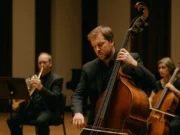


Halldór Úlfarsson’s Halldorophone: A Feedback-Based Electro-Acoustic String Instrument
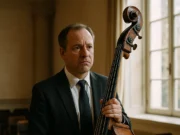
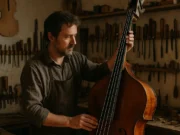
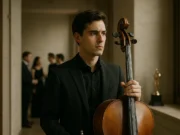
Halldór Úlfarsson has created the Halldorophone, an innovative string instrument that resembles a cello but is electro-acoustic in nature. What sets this instrument apart is its core design around the concept of audio feedback, which is intentionally harnessed by the artist and designer to generate rich, evolving sounds. Feedback occurs when sound produced by the instrument is captured through pickups or microphones, amplified, and then fed back into the instrument, creating a continuous sound loop amplified by the coupled strings.
The Halldorophone was exhibited at Sónar+D 2024 within the Intelligent Instruments Lab, alongside various research-driven musical systems. Attendees had the chance to play the instrument, often noting with surprise that its sound was unlike a traditional cello. This particular yellow Halldorophone was developed in collaboration with Dr. Adam Pulz Melbye, who contributed by programming algorithms, conducting user experiments, and studying audience perception of this unique instrument.
Images courtesy of Intelligent Instruments Lab | Video by Rafn Rafnsson, The University of Iceland
Functionality and Sound Production of the Halldorophone
The instrument features four strings arranged as two sets: the main strings, which the musician plays directly, and sympathetic strings, which vibrate naturally in response to the main strings’ resonance. Each string has an individual pickup that acts like a microphone, capturing its sound and sending it through an internal mixer that allows the player to control the volume of each string separately. The sound is then processed through an amplifier and speaker integrated into the instrument’s body, which projects the amplified sound back to the strings, generating feedback vibrations.
At the heart of the instrument’s audio processing is an embedded Bela microcomputer located beneath the mixing board. This microcomputer runs intelligent algorithms that modulate and enhance the natural feedback system, enabling more complex and dynamic sound behaviors. The interaction between the strings, pickups, amplifier, and microcomputer creates a continuous feedback loop, resulting in the instrument’s distinctive drone-like soundscape.
Advanced Feedback Control and Musical Expression
The feedback-driven design allows musicians to produce sustained, textured sounds known as drones. Players are able to control the loudness of each individual string as well as the overall speaker volume, which influences the intensity and strength of the feedback and string vibrations. The four main strings can be played with a bow, plucked, or gently rubbed to coax varied resonant tones from the instrument.
Distinctively, the Halldorophone’s fretless fingerboard enables smooth sliding between notes, providing expressive pitch control. The sympathetic strings, positioned just beneath the main strings, vibrate automatically in response to the played notes and contribute a subtle echoing, continuous background sound without direct contact.
Additionally, the instrument’s output can be connected to external audio devices such as effects processors or pedals. This connectivity allows performers to apply effects like reverb, delay, or distortion to further shape the sonic possibilities, similar to the approach electric guitarists use with pedals.
The Halldorophone gained broader recognition in early 2020 when Icelandic composer Hildur Guðnadóttir featured it in her Academy Award-winning soundtrack for the film Joker, showcasing the instrument’s unique sound capabilities in a cinematic context.
Source: Designboom
— The Violin Post Editorial Staff