





























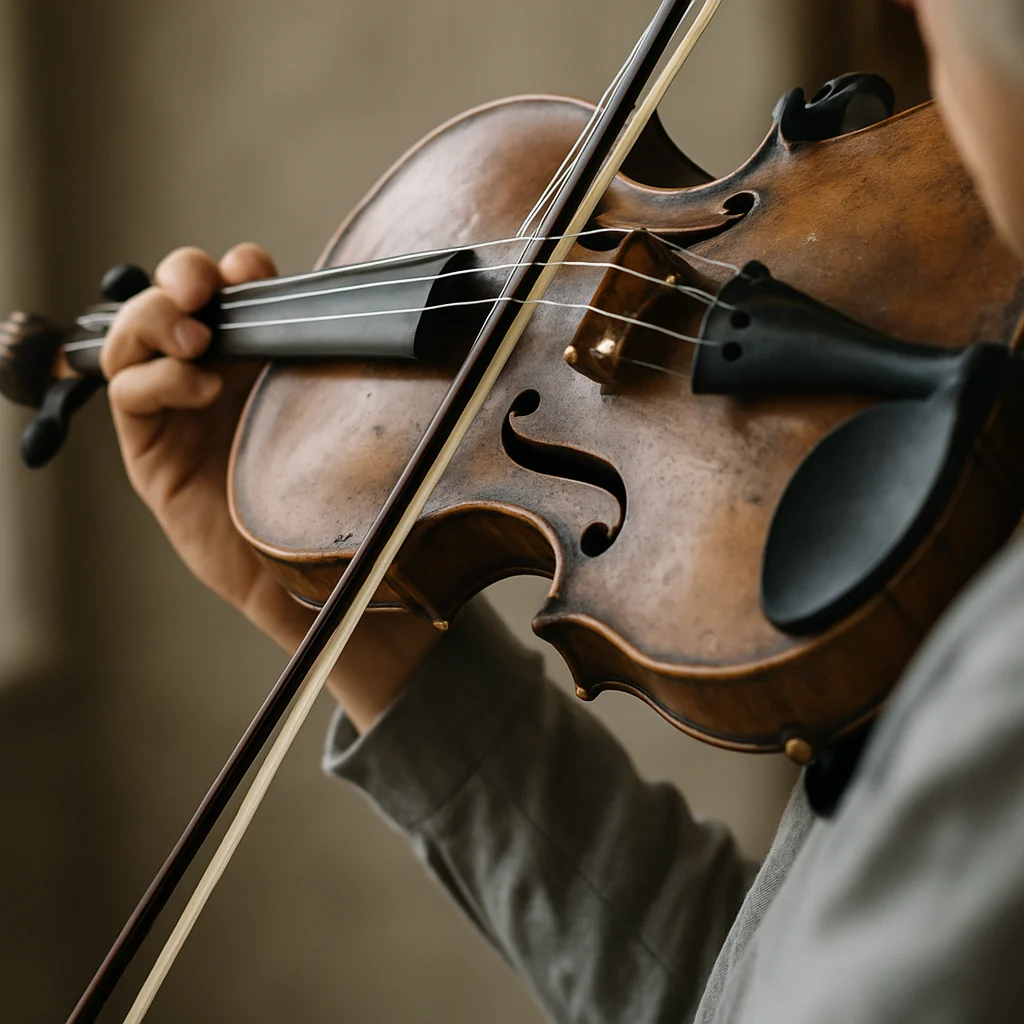
New Research Explores Why Older Violins Deliver Superior Sound Quality – Research & Innovation
Violin players have long cherished antique instruments, especially renowned Stradivari violins that can be valued at millions of pounds. Recent scientific studies have confirmed that certain older violins genuinely emit distinctive sounds characterized by pronounced combination tones. These bell-like “phantom” tones, produced when two musical notes are played simultaneously, enhance the instrument’s sonic richness, although not everyone can perceive them.
Among the most notable of these phenomena are Tartini tones, named after the Italian composer and violinist Giuseppe Tartini who first identified them in 1714. Historically, these terzo suono or “third sounds” were believed to be mere auditory illusions caused by distortions within the inner ear.
“The Tartini tones are very subtle, bell-like vibrations that consistently produce the same note based on the chord being played,” explained Christian Lloyd, managing editor of The Strad magazine. “Musicians find them interesting because these tones are only audible when playing perfectly in tune.”
Research led by Giovanni Cecchi at the University of Florence, Italy, has recently demonstrated that these combination tones can be measured outside the ear, but only when two notes are played simultaneously on the same violin. Further examination revealed that some violins generate these tones much more clearly than others.
In their study published in the Journal of the Acoustical Society of America, the team engaged a professional violinist to perform pairs of notes called dyads on five violins: a Tononi violin dated to 1700, an anonymous Italian violin from the 18th century, a 19th-century London-made violin by Henry Lockey Hill, a handcrafted violin from 1971, and a modern factory-produced violin.
The findings indicated that combination tones were significantly stronger and more perceptible on high-quality older instruments compared to newer, lower-quality violins. “The most prominent combination tone was observed in an old Italian violin crafted in Bologna in 1700 by Carlo Annibale Tononi,” Cecchi noted. “Violins of inferior quality showed almost negligible combination tones.”
Previously, it was assumed that the combination tones produced by violins were too faint to influence sound perception, thus considered unimportant. Cecchi commented, “Our study challenges this assumption by showing that well-made violins produce combination tones that are easily heard, enriching the harmonic character of the notes and enhancing the listening experience.”
Lloyd pointed out the significance of detecting these tones externally, though he expressed skepticism about the claim that only older violins can produce them. “With modern technology and access to premium quality wood, today’s leading luthiers are crafting instruments comparable to those of Stradivari and Guarneri,” he said.
Cecchi added that upcoming research will examine a broader assortment of violins to better understand the specific physical attributes that generate these combination tones.
— The Violin Post Editorial Staff