





























From Anhui Village to Global Recognition: Chen Fengjun’s Rise as a Master Violin Maker – Luthier & Making
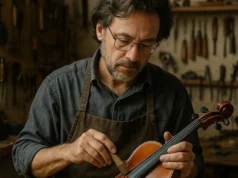
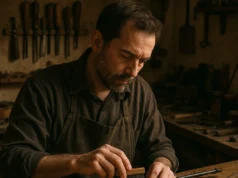
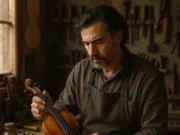
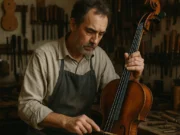
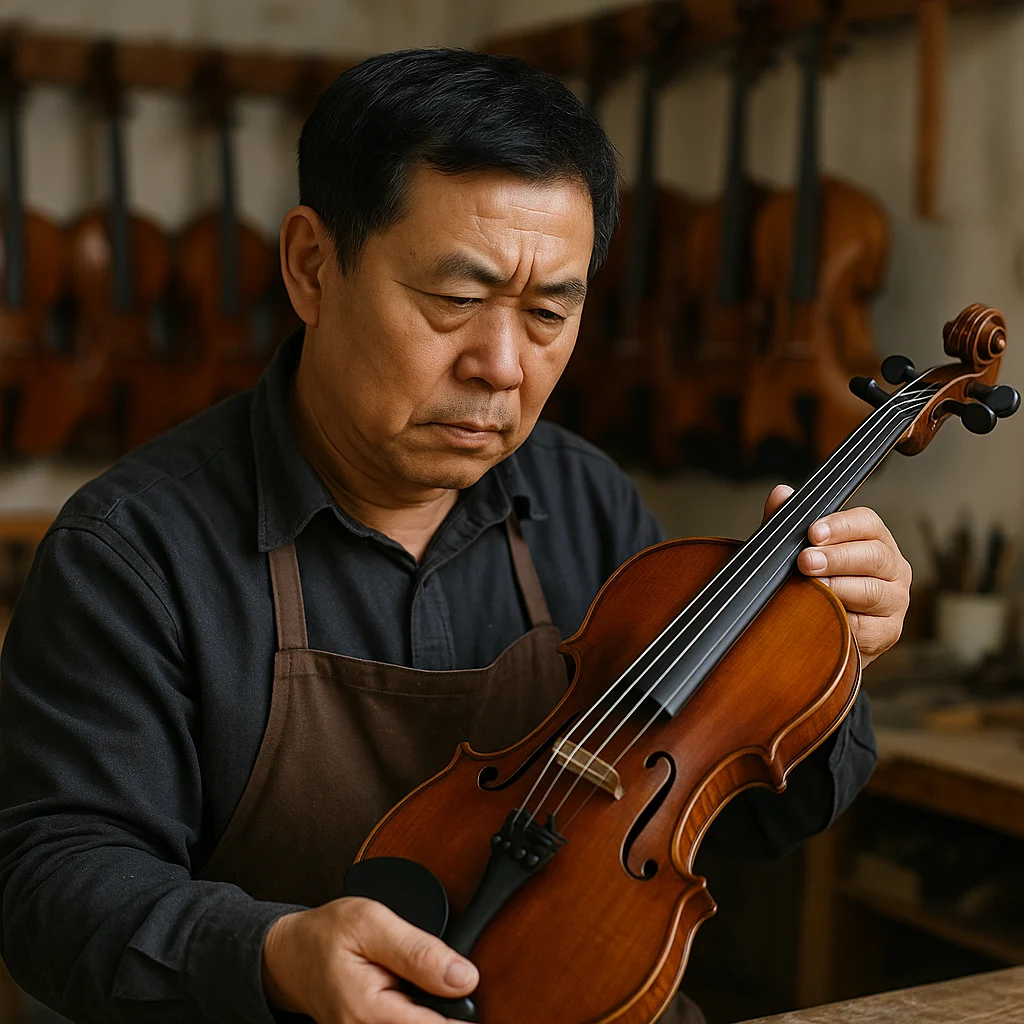
On July 1, 2024, Chen Fengjun was captured at work in his workshop located in Donggaocun Town, Pinggu District, Beijing, illustrating the heart of China’s evolving violin-making industry.
Chen’s journey began some 24 years ago, when he left his rural home in eastern China’s Anhui Province to study the craft of violin-making in what was then a modest farmhouse-turned-workshop in a village on the outskirts of Beijing. At that time, Donggaocun was not known for violins but rather for its cultivation of sweet, juicy peaches.
Over the years, Chen’s skill and dedication elevated him to the status of a world-class luthier. His talents were internationally recognized when he won the gold medal at the 2014 “Violin: Soul and Shape” international competition. Today, his finely crafted violins are prized by prominent musicians globally.
Chen’s personal growth mirrored the expansion of the violin-making industry in Pinggu District. Since his arrival in 2000, the area transformed into what is now called Beijing International Music Valley, home to hundreds of violin makers. Notably, more than 80% of the violins produced there are exported to over 30 countries and regions.
The path to mastery was fraught with challenges. Chen found violin-making far more complex than anticipated, often investing hours into crafting delicate components like fingerboards, only to have his efforts rejected by his master. His perseverance was tested by accidents, including a severe injury in 2003 when his left middle finger nearly severed due to a planer machine mishap. Despite this, Chen’s finger was saved, and the resulting scar serves as a testament to his resilience.
Chen attributes the secret of his success to patience and relentless practice, echoing advice from his uncle who initially introduced him to the trade. His workshop walls are lined with a variety of specialized tools, each serving a distinct purpose in the intricate process that involves over a hundred detailed steps to create a single violin.
Early in his career, Chen diligently learned from seasoned artisans and meticulously documented every detail in a notebook, dedicating months to mastering individual segments of violin-making, such as fingerboard construction.
With his stature as an award-winning craftsman, Chen continues to refine his methods, recording precise measurements and details for each instrument. He acknowledges that even minor alterations in the violin’s components can significantly impact its sound quality.
The expertise of luthiers like Chen has helped establish China’s dominance in the global violin market. According to Gregg Alf, a member of the International Association of Violin and Bow Makers, China exports more than one million violins annually, representing over half of worldwide production.
Chen remains committed to continuous improvement, embracing diverse disciplines such as chemistry, machinery, art, and carpentry to perfect his craft. Reflecting on his lifelong dedication, he states, “I will continue making violins, until I can’t do it anymore.”
— The Violin Post Editorial Staff