


































When two musical notes are played simultaneously, listeners often perceive additional faint tones known as combination tones. These subjective tones originate from the nonlinearity of the inner ear, particularly the cochlea’s amplification process, and their perception varies among individuals. Beyond these subjective effects, some musical instruments also produce objective combination tones—sounds that exist in the surrounding air and can be detected with sensitive microphones and recorded for analysis.
A collaborative study by researchers from Italy, including teams from the Conservatorio Musicale Lorenzo Perosi, the Università di Firenze, and the Istituto di Scienza e Tecnologia dell’Informazione, investigated these objective combination tones in violins. Their findings, published in the Journal of the Acoustical Society of America, reveal that high-quality violins produce combination tones that are significantly stronger and more audible than previously thought.
“Until now, combination tones generated by violins were considered too faint to impact musical experience and thus largely disregarded,” explained Giovanni Cecchi of the Università di Firenze, a co-author of the study. “Our findings demonstrate that violins of superior quality emit combination tones that are distinctly audible and influence how musical intervals are perceived.”
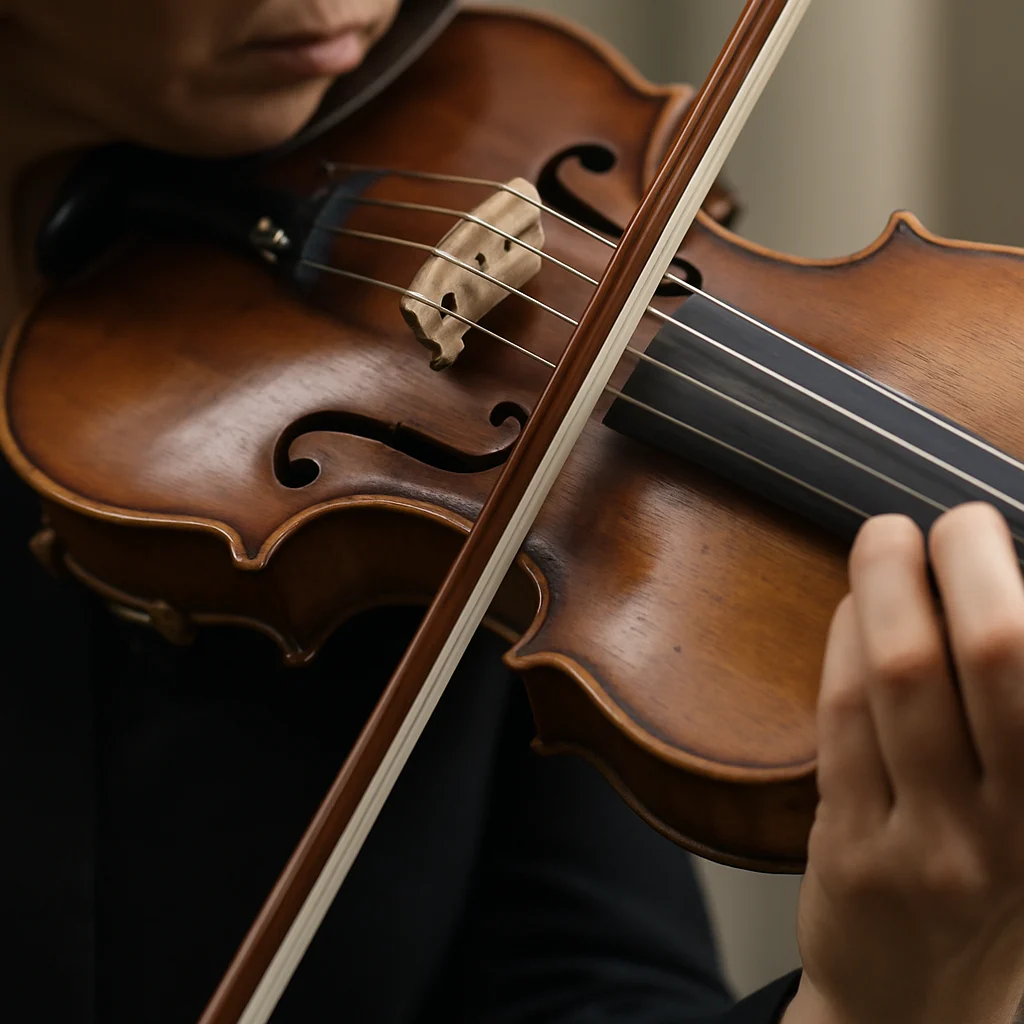
For the research, a professional violinist performed a series of two-note combinations, known as dyads, using five violins varying in age and craftsmanship. The emitted sounds were recorded and analyzed to identify the presence and characteristics of combination tones.
Results showed that every violin produced combination tones during dyadic play, typically strongest at frequencies below the lower note of the two played. These tones result from the violin’s harmonic distortions and the resonance of air within its body, factors contributing uniquely to each instrument’s acoustic signature.
Notably, the combination tones were substantially more pronounced in the superior violins. The most powerful tone was detected in an antique Italian violin crafted around 1700 in Bologna by Carlo Annibale Tononi, a renowned luthier. Conversely, violins of lesser quality emitted barely perceptible combination tones.
The study establishes a link between robust air resonance inside the violin body and sound quality. High-quality violins exhibit stronger air resonance peaks, influenced by their construction materials and manufacturing techniques, which amplifies combination tone strength.
Looking ahead, the research team plans to examine a broader array of violins to pinpoint the specific components responsible for generating these combination tones.
Publication Details
The article titled “Characteristics, mechanisms, and perceivability of combination tones in violins” by Gabriele Caselli, Giovanni Cecchi, and Giulio Masetti was published on November 1, 2022, in the Journal of the Acoustical Society of America. The study is accessible via DOI: 10.1121/10.0014600.
About the Journal and Society
The Journal of the Acoustical Society of America (JASA) has provided leading research in the interdisciplinary field of sound since 1929. It serves a wide community including scientists, engineers, psychologists, musicians, and more. The journal is published on behalf of the Acoustical Society of America (ASA), the foremost international scientific society focused on acoustics. ASA supports over 7,000 members worldwide, offering research publications, scientific meetings, and standards related to the science and technology of sound. For further information, visit JASA website and ASA website.
— The Violin Post Editorial Staff