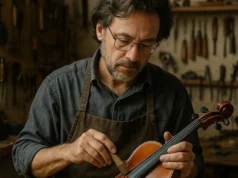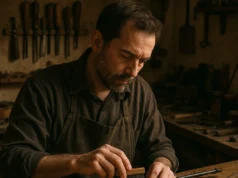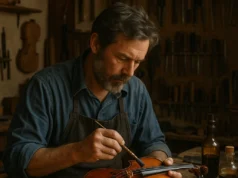



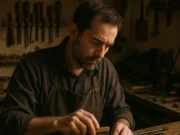
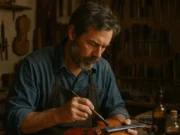
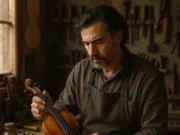
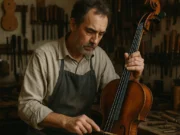







Centuries ago in Italy, the famed violin makers Antonio Stradivari and Giuseppe Guarneri perfected their craft, setting enduring standards that continue to define violin making worldwide. Their violins remain the epitome of excellence, revered as the holy grail among string instruments.
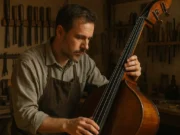
In Kerala’s Kochi region, a remarkable father-son team has embraced this rich legacy, earning recognition as among the few certified Indian luthiers capable of handcrafted replicas of prestigious European violins. This rare dedication to the art of lutherie—the meticulous craft of building stringed instruments—underscores their commitment to preserving these revered traditions in India.
From Humble Beginnings to Master Luthiers
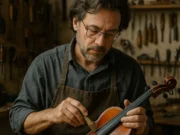
ED Murali’s journey began in the 1980s as a guitar student at Cochin Arts and Communication (CAC). Originating from a carpenter’s family, his woodworking skills proved invaluable when he began repairing violins for friends. By 1985, Murali had transitioned to full-time violin repair, crafting his first instrument from jackfruit wood, selling it for Rs 150.
Today, Murali works with carefully seasoned imported woods, creating high-end violins valued at lakhs. He emphasizes the unmatched personality and tonal quality that only a handmade violin can offer, unattainable by factory-produced instruments. “Lutherie requires a devoted artisan. We have mastered this craft to reproduce exact replicas of European masterpieces, including models by 17th-century Italian pioneers Stradivari and Guarneri,” he states.
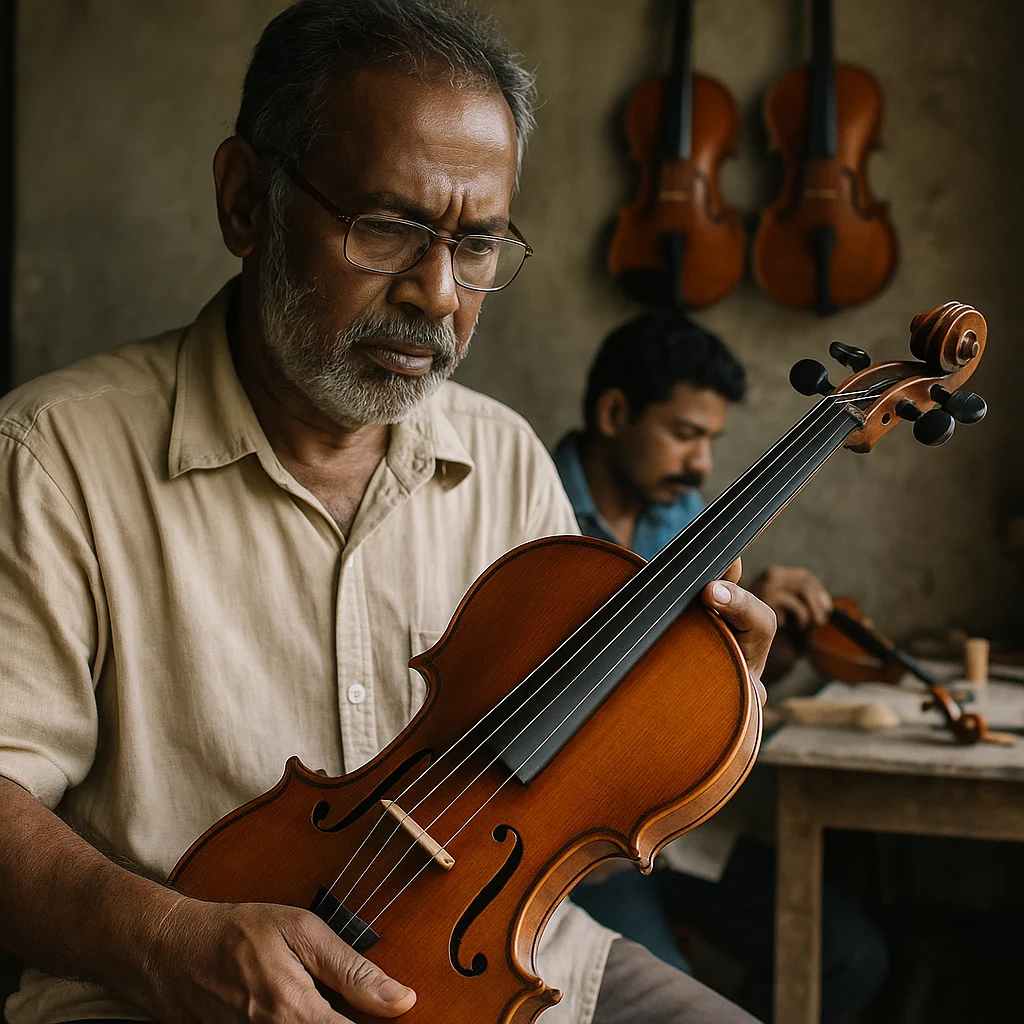
Supporting Murali are his sons, Vijay and Vinay, who collaborate within their modest workshop, ‘Fiddle Crafters Luthiers,’ located near their home in Chendamangalam village, Kerala.
Devotion and Precision in Crafting
Vinay highlights the intensity of the process: “Creating a Stradivarius violin by hand demands approximately 300 hours, filled with intricate detailing where even a one-millimeter error can significantly affect sound quality.” Vinay crafted his first violin in 2012 at age 14, learning the craft from his father while also taking formal violin lessons at CAC.
Elevating Indian Violin Making
While the violin holds a vital place in Indian, especially Carnatic, music traditions, India lacked luthiers capable of flawless European violin replicas, forcing musicians to rely on expensive imports. The turning point came in 2013 when Murali participated in Violin-Wise workshops in Chennai, organized by the Lalgudi Trust and led by esteemed American luthier James Wimmer.
These workshops provided Murali with advanced tools and refined techniques, greatly enhancing his craftsmanship. Both Murali and Vinay attended these workshops—Murali all five sessions and Vinay the last in 2019. They successfully crafted precise replicas of the iconic 1702 Stradivarius violin thereafter.
“Wimmer personally selected participants and even visited our workshop in Chendamangalam, gifting us rare tools unavailable in India,” recalls Murali.
Tailored Instruments for Indian and Western Musicians
The family now focuses exclusively on crafting high-end violins. Despite their premium price, the instruments attract accomplished violinists, such as Kumaresh of the Ganesh-Kumaresh duo and Edappally Ajith Kumar, since serious musicians prefer handmade over factory-made instruments. Their workshop also produces quality violas and electric violins, with plans to export handcrafted violins in the future.
Customization is key: “Depending on the buyer’s choice between Stradivari or Guarneri models, we adapt violins for Western or Carnatic styles—for instance, extending the neck for Carnatic players who play seated cross-legged on the floor. Our violin for Kumaresh features a longer neck yet retains authentic tone quality,” explains Vinay.
Exceptional Craftsmanship and Lasting Legacy
Each violin crafted at the Chendamangalam workshop offers exquisite tonal quality rivaling European originals. “No two violins are identical—even when made from the same mould, each has a unique voice, a signature of its maker. A handcrafted violin is a timeless treasure, often lasting three generations, with value appreciating like fine wine,” Vinay notes. He reflects on lutherie as an ongoing creative pursuit where perfection is an evolving quest.
The Laborious Art of Violin Making
The process begins with selecting premium woods—maple and spruce seasoned for at least 15 years—imported from France and Germany. These woods grow in alpine cold climates, resulting in dense, strong, and defect-free material that enhances sound quality. More luxurious violins use wood seasoned up to 50 years.
Spruce forms the sound posts and front plate; maple is shaped into the back, neck, and ribs. Ebony, a hard wood from Northeast India and Sri Lanka, is used for pegs and tailpieces. Strings, bows, and cases come from Germany and Singapore.
“While the raw wood totals about 2.5 kg, the finished violin weighs roughly 450–470 grams,” shares Vinay. Components are hand-carved with precision tools, and animal or bone glues are used to bond parts for durability and ease of repair.
The family crafts traditional varnish from tree sap and vegetable oil, applying it by hand to produce violins with exceptional sonority and aesthetic elegance.
— The Violin Post Editorial Staff