



















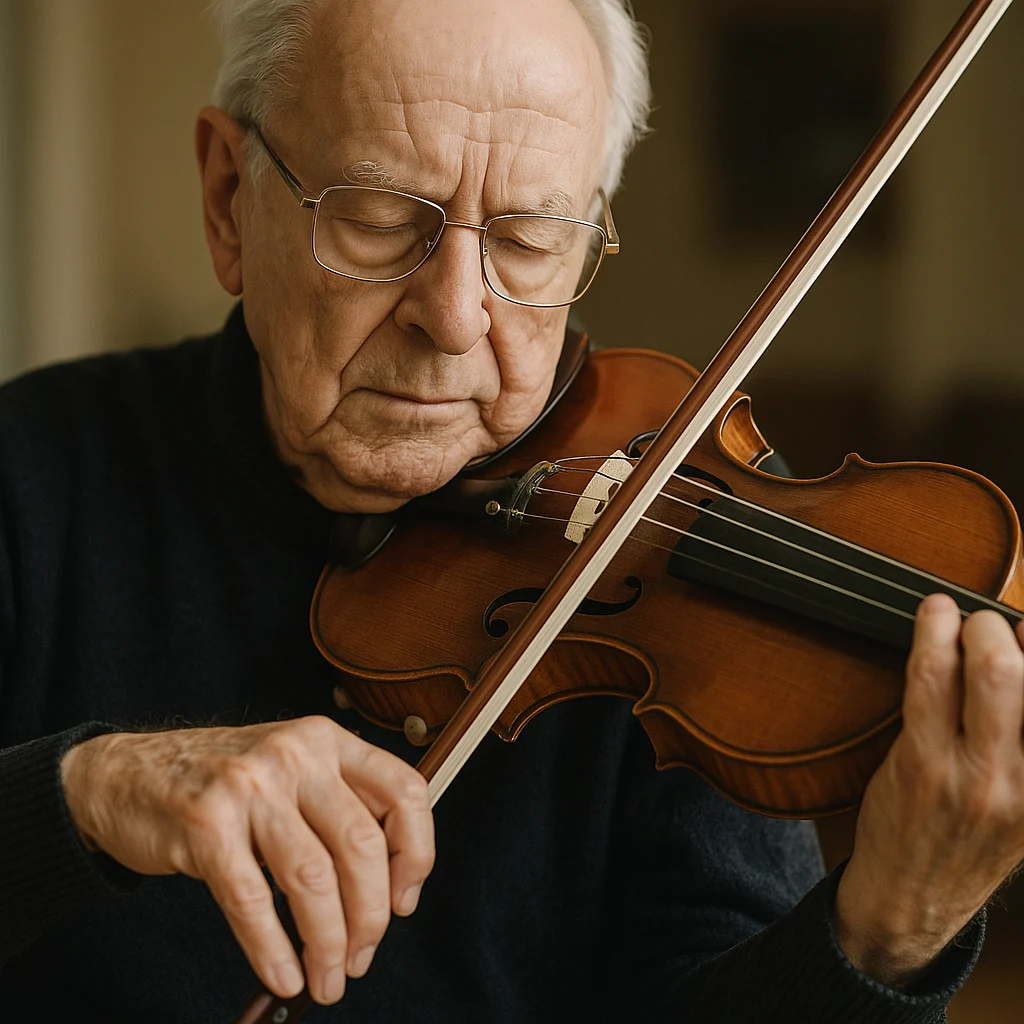
On March 27, 2024, the world of classical music mourned the loss of Igor Ozim, a distinguished Slovenian violinist and pedagogue who profoundly shaped the careers of many prominent violinists, including Patricia Kopatchinskaja, Richard Tognetti, Kurt Sassmannshaus, Aleksey Igudesman, and Peter Rundel. His influence extends to current and former concertmasters and leaders of renowned orchestras such as the Berlin Philharmonic, Bavarian Radio Symphony, Zürich Tonhalle Orchestra, Dresden Staatskapelle, and the Orchestra of the Royal Opera House.
Kurt Sassmannshaus, who holds the Dorothy Richard Starling Chair for Classical Violin at the University of Cincinnati College-Conservatory of Music, expressed his deep gratitude for Ozim’s teaching, saying, “Not one day of teaching goes by without the thought: ‘I learned that from Igor Ozim.’ What an exemplary teacher, violinist, musician, and amazing role model. I am forever grateful.”
At the time of his passing, Ozim was based in Salzburg, Austria, where he served as a professor at the Salzburg Mozarteum, a leading institution in music education.
Early Life and Education
Igor Ozim was born in Ljubljana in 1931 into a musical family. He began violin lessons at the tender age of five under Leon Pfeifer, who was a student of the legendary pedagogue Otakar Ševcík, at the Academy of Music in Ljubljana. In 1949, Ozim received a British Council scholarship to study at London’s Royal College of Music. There, he notably studied the Elgar Violin Concerto with Albert Sammons, one of the concerto’s foremost interpreters, and later continued his studies for two years under Max Rostal.
Achievements and Career Highlights
Ozim’s artistry was recognized with several competition victories, including first prizes at the International Carl Flesch Violin Competition in 1951 and the ARD International Music Competition in Munich in 1953.
Throughout his career, Ozim maintained a vast repertoire of approximately 60 violin concertos and an extensive range of chamber music. He toured extensively as a soloist and recitalist across Europe, the Soviet Union, the United States, Australia, New Zealand, and the Far East. He graced the stage with celebrated orchestras such as the Berlin Philharmonic, London Philharmonic Orchestra, London Symphony Orchestra, BBC Symphony Orchestra, and Warsaw Philharmonic Orchestra.
His discography includes recordings of Mozart’s piano trios and Schubert chamber music, along with violin concertos by Slovenian composers Slavko Osterc, Lucijan Marija Škerjanc, Ivo Petric, Janez Maticic, and Uroš Krek. Ozim also contributed to the violin repertoire through published editions, including those of Mozart’s violin concertos and works spanning both classical and contemporary compositions.
Legacy as a Teacher
Patricia Kopatchinskaja, an internationally acclaimed violinist who studied under Ozim at the Bern Conservatory from 1997 to 1999, shared a heartfelt tribute on social media. She recalled how Ozim, upon learning of her financial difficulties, generously provided lessons free of charge and later helped secure a scholarship for her.
“He was always elegantly dressed, with his violin in hand. His students were distinguished by their seriousness and determination,” Kopatchinskaja wrote. She praised his insightful explanations of musical pieces, clear instructional guidance, and detailed knowledge of historical performance practices. His expertise extended naturally to contemporary music, and he actively collaborated with living composers.
Kopatchinskaja also highlighted Ozim’s political awareness and his habit of discussing the historical context behind the music they studied. Remarkably, he was capable of accompanying all sonatas on the piano, an uncommon skill for a violinist.
She reflected on how her studies with Ozim transformed her artistic approach, emphasizing the power of logic and discipline in mastering the violin. She humorously noted a common jest that Ozim could teach even a monkey to play the violin flawlessly.
His teaching style was marked by total dedication, encouraging punctuality, diligence, and seriousness. He tailored practice tasks to each student to guarantee success. Kopatchinskaja quoted him advising, “Patricia, you can’t throw sooooo many colours onto the canvas all at once, and then even over the edge! At least stick to the frame of your picture! Nobody will buy anything beyond that.”
She expressed personal gratitude, stating, “I went to him feeling I was receiving a gift, listened intently, and endeavored to learn all I could.” She poignantly noted that Ozim’s passing on her birthday made their connection even more meaningful, promising to remember him fondly in all of life’s moments.
Personal Life and Final Years
Igor Ozim is survived by his wife, Wonji Kim. A video from January 2008 captures Ozim conducting a master class at the Escuela Superior de Música Reina Sofía in Madrid, working closely with student Jaime Mingarro Rodrigo on the opening measures of Mozart’s Violin Concerto No. 5.
A recently published book on string pedagogy, Teaching Violin, Viola, Cello, and Double Bass, includes a summary of Ozim’s teaching principles (pages 129–130) as well as his “Vibrato Prayer,” demonstrating his thoughtful approach to violin technique:
Grant me that I vibrate
all first and fourth fingers
the first short note after the long note
the last note before a shift
the first note after a shift
when crossing a string
and in diminuendo
Amen
Igor Ozim’s remarkable career as both a performer and educator left an indelible mark on the world of violin music. His influence endures through his students and the many musicians he inspired.
— The Violin Post Editorial Staff