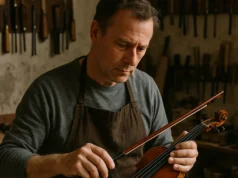















Cremona is not simply a city.
It is a responsibility passed down through centuries of craftsmanship, sound, and knowledge.
Giuseppe Stefano Conca and the Guadagnini Competition: Preserving Cremonese Tradition in a Contemporary World
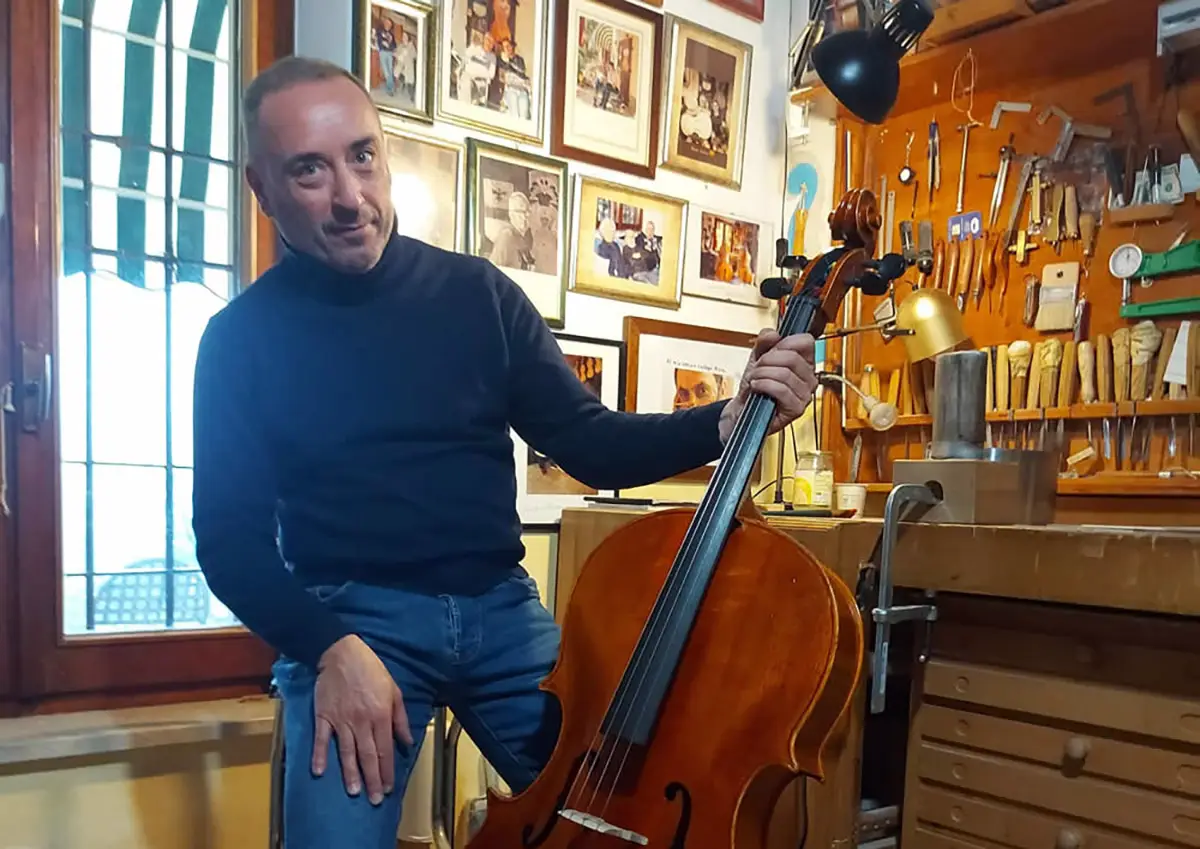
In today’s world of violin making—where visibility often moves faster than depth—the challenge is no longer just to preserve tradition, but to understand it well enough to make it meaningful in the present. Few figures represent this balance as clearly as Giuseppe Stefano Conca, Secretary and organizer of the International Giovanni Battista Guadagnini Violin Making Competition.
Born in Cremona in 1966, Conca’s path into violin making was not driven by profession, but by a long-matured passion. At the age of forty-eight, he co-founded Academia Cremonensis together with Master luthier Giovanni Colonna and engineer Massimo Lucchi—a project conceived as a place for serious, methodical study of traditional Cremonese violin making.
At the Academia, Conca served not only as President but also as Managing Director, holding educational conferences for visitors and participating in international cultural contexts such as Expo 2015 in Milan. Teaching, for him, became a way to refine understanding: explaining violin making means confronting its principles, its history, and its responsibilities.
His education was deeply hands-on. Under the private guidance of Giovanni Colonna, Conca followed a rigorous theoretical and practical training path, culminating in December 2015 with the official certification of competence as a luthier issued by the Lombardy Region. It was a milestone that validated years of disciplined study rather than casual experimentation.
Tradition, in Conca’s view, is not imitation. His references—Stradivari, Amati, Guarneri del Gesù, and Sacconi—are not models to replicate mechanically, but sources of knowledge. The goal is fidelity to the traditional Cremonese working method, while allowing personal identity to emerge naturally in each instrument.
A central element of this approach is the study of wood. At Academia Cremonensis, Conca took part in the creation of a xylotheque, deepening his understanding of tonewood through direct research. Visits to the Paneveggio Forest of Musicand the Balkan regions reinforced a crucial idea: wood selection is not merely technical, but acoustic and cultural.
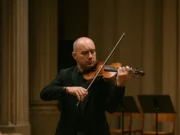
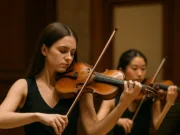
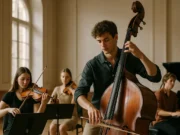
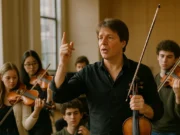
Equally formative was the direct contact with musicians. Frequent visits by professional performers to the Academia offered invaluable insight into real-world needs—sound projection, balance, response, and playability. These elements, often overlooked in theory, define the life of an instrument on stage.
The study of varnish completed this journey. Beginning with the distillation of natural pigments and their chromatic properties, Conca expanded his research through participation in national and international conferences, including at the Conservatory of Bilbao, refining both technical knowledge and aesthetic sensitivity.
After leaving Academia Cremonensis in 2018, Conca continued his path privately at the workshop of Bruno Pedroni. Though interrupted by the pandemic, this experience resumed in 2022, leading to the completion of his first fully realized instruments, always rooted in the traditional Cremonese method.
Today, all these experiences converge in his role within the Giovanni Battista Guadagnini Competition. The competition is not conceived as a spectacle, but as a serious point of reference—a place where instruments are evaluated with rigor, coherence, and respect for craftsmanship. Deeply connected to Cremona yet open to the world, it represents a bridge between historical awareness and contemporary violin making.
In an era where speed often replaces depth, the Guadagnini Competition sends a clear message: quality takes time. And preserving tradition means carrying it forward with knowledge, integrity, and responsibility.