



















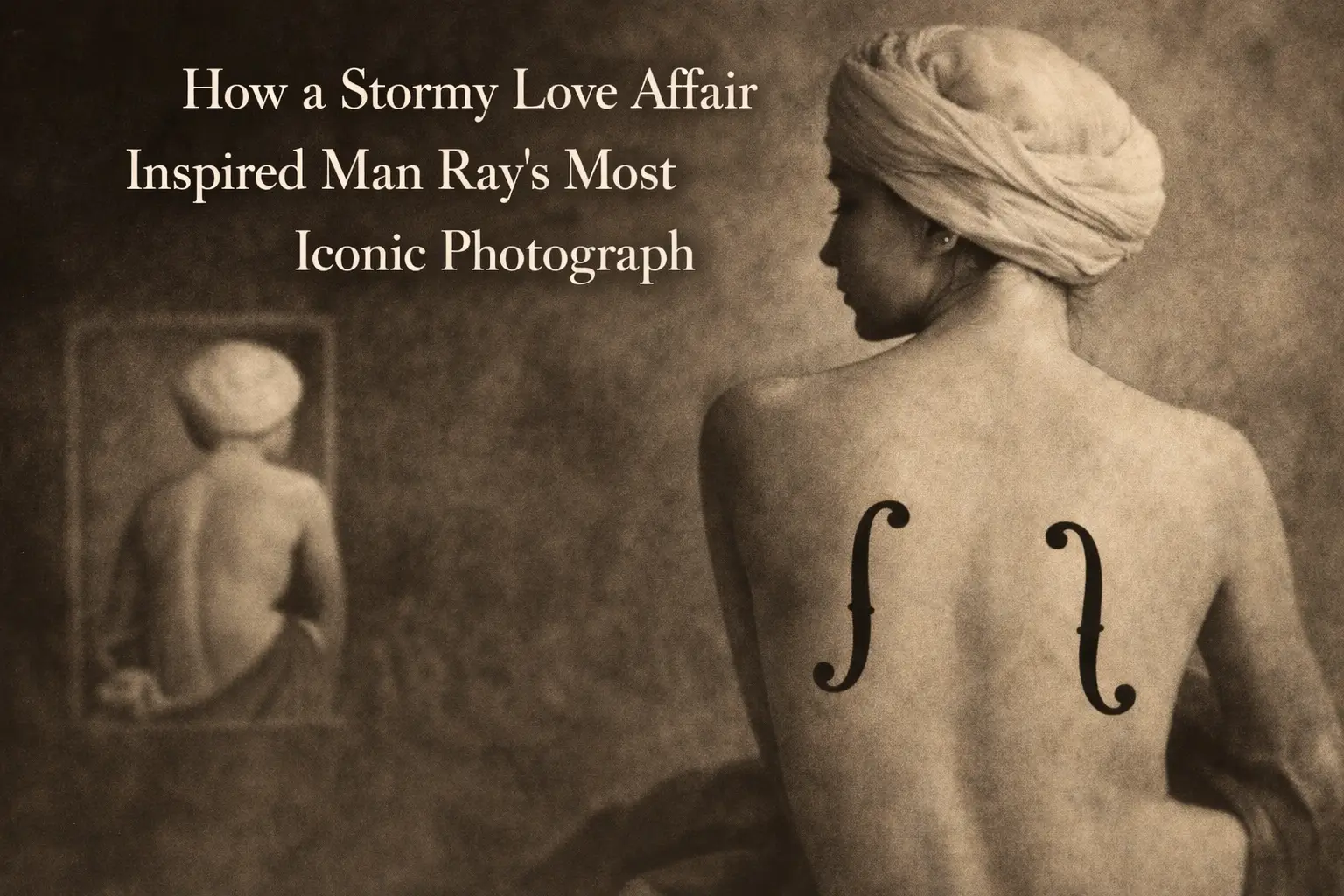
Few images in the history of photography are as immediately recognisable—or as richly layered—as Le Violon d’Ingres(1924), the celebrated photograph by American-born artist Man Ray. At once sensual, surreal, and deeply symbolic, the work depicts a nude woman seated from behind, her head wrapped in a turban, with the f-holes of a violin seemingly inscribed on her back.
How a Stormy Love Affair Inspired Man Ray’s Most Iconic Photograph – History
Nearly a century after its creation, the photograph continues to fascinate audiences worldwide. In May 2022, an original print shattered records at Christie’s New York, selling for an extraordinary $12.4 million, becoming the most expensive photograph ever sold at auction.
Behind the image lies not only artistic ingenuity, but also a turbulent and passionate romantic relationship.
A Muse and a Lover: Man Ray and Kiki de Montparnasse
The model in Le Violon d’Ingres is Kiki de Montparnasse, born Alice Prin, a cabaret star, artist’s muse, and emblem of Parisian bohemia in the 1920s. Man Ray met Kiki by chance in a café in 1921, and the two embarked on an intense eight-year relationship marked by both creative collaboration and emotional volatility.
Kiki, raised in poverty and largely self-taught, became one of the most frequently depicted women of her generation. Artists including Tsuguharu Foujita, Francis Picabia, Alexander Calder, and Chaïm Soutine captured her likeness. With her jet-black bob and scarlet lips, she embodied the liberated woman of postwar Paris.
Yet in Le Violon d’Ingres, Man Ray strips away her public persona, focusing instead on her body as form and symbol—transforming his muse into an object of sound, desire, and artistic control.
A Dialogue with Art History
The title Le Violon d’Ingres plays on a French idiom meaning “a hobby,” derived from the Neoclassical painter Jean-Auguste-Dominique Ingres, who was also an accomplished violinist. Man Ray, a devoted admirer of Ingres, consciously embedded references to the painter’s work.
The pose of Kiki recalls Ingres’s famous nudes, including The Valpinçon Bather and The Turkish Bath, both depicting women from behind, often wearing turbans. These visual echoes would have been instantly recognisable to a Parisian audience of the time.
By superimposing violin f-holes onto Kiki’s back, Man Ray merges music, painting, photography, and the female form into a single surreal image—blurring the boundaries between medium, metaphor, and meaning.
Technique and Innovation
Contrary to popular belief, the f-holes were not painted directly onto the body. For the most famous print—now part of the Metropolitan Museum of Art’s collection—Man Ray employed a darkroom technique. Using a stencil, he exposed the shapes onto photographic paper before re-exposing the image of Kiki, fusing the elements into one seamless composition.
Only two original prints were made in 1924. One belonged to surrealist writer André Breton; the other, known as the Jacobs print, is currently on view at the Met as part of Man Ray: When Objects Dream, on display through February 1, 2026.
The Violin as Symbol
Throughout modern art, the violin has carried powerful symbolic weight. Picasso and Braque deconstructed it in Cubist experiments; Marc Chagall imbued it with themes of memory, ritual, and Jewish identity.
Man Ray, born to Russian Jewish parents, may have been aware of these resonances. Art historians have also noted parallels with 17th-century Dutch paintings, where musical instruments often symbolised invitation, intimacy, and desire.
Late in life, Man Ray revisited Le Violon d’Ingres, adding actual violin strings across the image—suggesting that the photograph itself could be “played,” completing the metaphor he had introduced decades earlier.
A Photograph That Still Resonates
Today, Le Violon d’Ingres stands not only as a landmark of Surrealist photography, but also as a deeply personal work—born from love, obsession, and artistic daring. It continues to provoke questions about authorship, power, desire, and the role of the muse, ensuring its relevance for generations to come.