












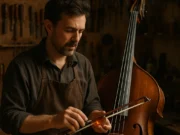























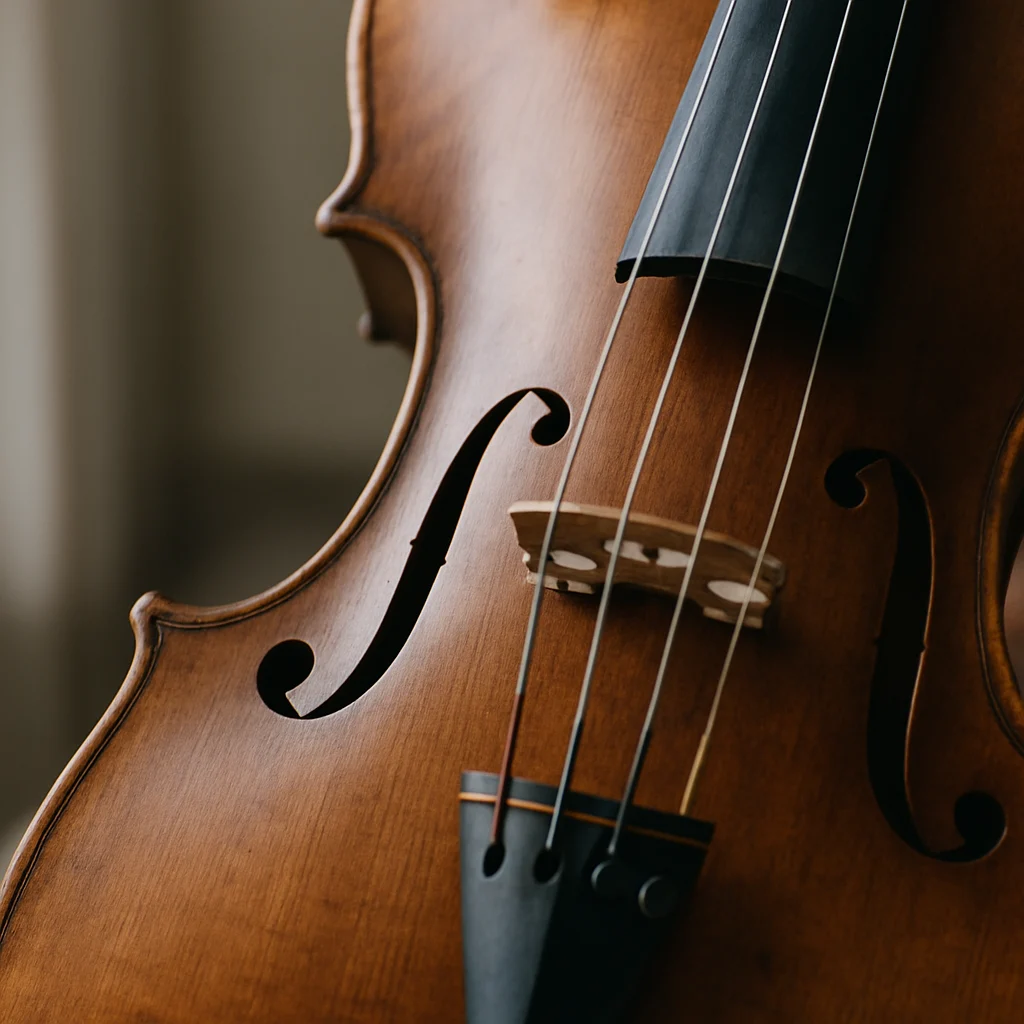
Before the advent of electronic amplification, instrument makers and musicians faced the challenge of enhancing their sound so it could be heard clearly within ensembles, orchestras, and noisy venues. Many acoustic instruments familiar today, including guitars, cellos, violas, and violins, evolved through centuries of experimentation aimed at improving sound amplification. These instruments employ hollow wooden chambers that naturally amplify string vibrations. However, the amplified sound must escape the body of the instrument, which is why acoustic guitars feature circular sound holes beneath the strings, and violins are equipped with distinctive f-shaped sound holes on either side of their front plates.
The unique f-hole shape found on violins has long intrigued observers and was often assumed to be an ornamental design holdover from the Renaissance era. While it is true that f-holes first appeared during the Renaissance, their function extends far beyond decoration. Whether through chance or intentional design, the f-hole has endured for centuries due to its remarkable acoustic advantages.
In groundbreaking research published by the Royal Society, acoustician Nicholas Makris and colleagues at MIT demonstrated that violin f-holes deliver acoustic power significantly superior to earlier sound hole shapes. According to The Economist, f-holes provide “twice the sonic power” of the circular holes used in the violin’s early ancestor, the medieval fithele (from which the word “fiddle” derives).
The progression to the current f-hole design was incremental, as highlighted by journalist Clive Thompson with a color-coded historical chart. The design journey began with simple round holes, evolved through half-moon and various elaborate c-shaped openings, and ultimately culminated in the f-shaped holes recognized today. This slow, consistent refinement suggests a natural evolution in instrument design instead of sudden invention. This historical development challenges theories, such as one depicted in a popular video, which speculates that Renaissance violin makers like the Amati family derived the f-hole shape by flattening the surface area of a peeled clementine—though the idea remains an intriguing anecdote.
Examining 470 instruments crafted between 1560 and 1750, Makris, his team, and violin maker Roman Barnas discovered that changes in sound hole shape were gradual and consistent over time. Similar to biological evolution, these design adjustments resulted from “natural mutation,” in this case, subtle craftsmanship variations and unintentional imperfections. Once luthiers such as the Amati, Stradivari, and Guarneri families perfected the f-hole, they recognized its superior acoustic properties and tended to replicate it intentionally. Whether or not these master craftsmen understood the underlying mathematical acoustics is uncertain.
Makris and colleagues identified a direct relationship between the conductance of sound from the instrument and the perimeter length of the sound hole. In simpler terms, more elongated sound holes enable greater escape of sound from the violin body. Additionally, an elongated hole occupies less surface area on the violin’s plate while still maintaining full sound production, representing a power-efficient design superior to previous hole shapes. It was only towards the end of the Renaissance period that f-holes became noticeably longer, consistent with deliberate modifications by makers. However, this final form appears to represent an optimum acoustic solution, as 19th-century attempts to alter f-hole designs further proved detrimental and were not adopted long term.
For readers interested in the detailed mathematical explanation of the f-hole’s acoustic superiority, Makris and his co-authors’ full paper is available through the Royal Society. Additionally, there are contemporary demonstrations available that show the precise process by which modern violin makers cut f-holes into the instrument.
Note: This article is an updated version of a post originally published in 2016.
Related Information:
Josh Jones is a writer and musician based in Durham, NC. Follow him on Twitter at @jdmagness.
— The Violin Post Editorial Staff