




































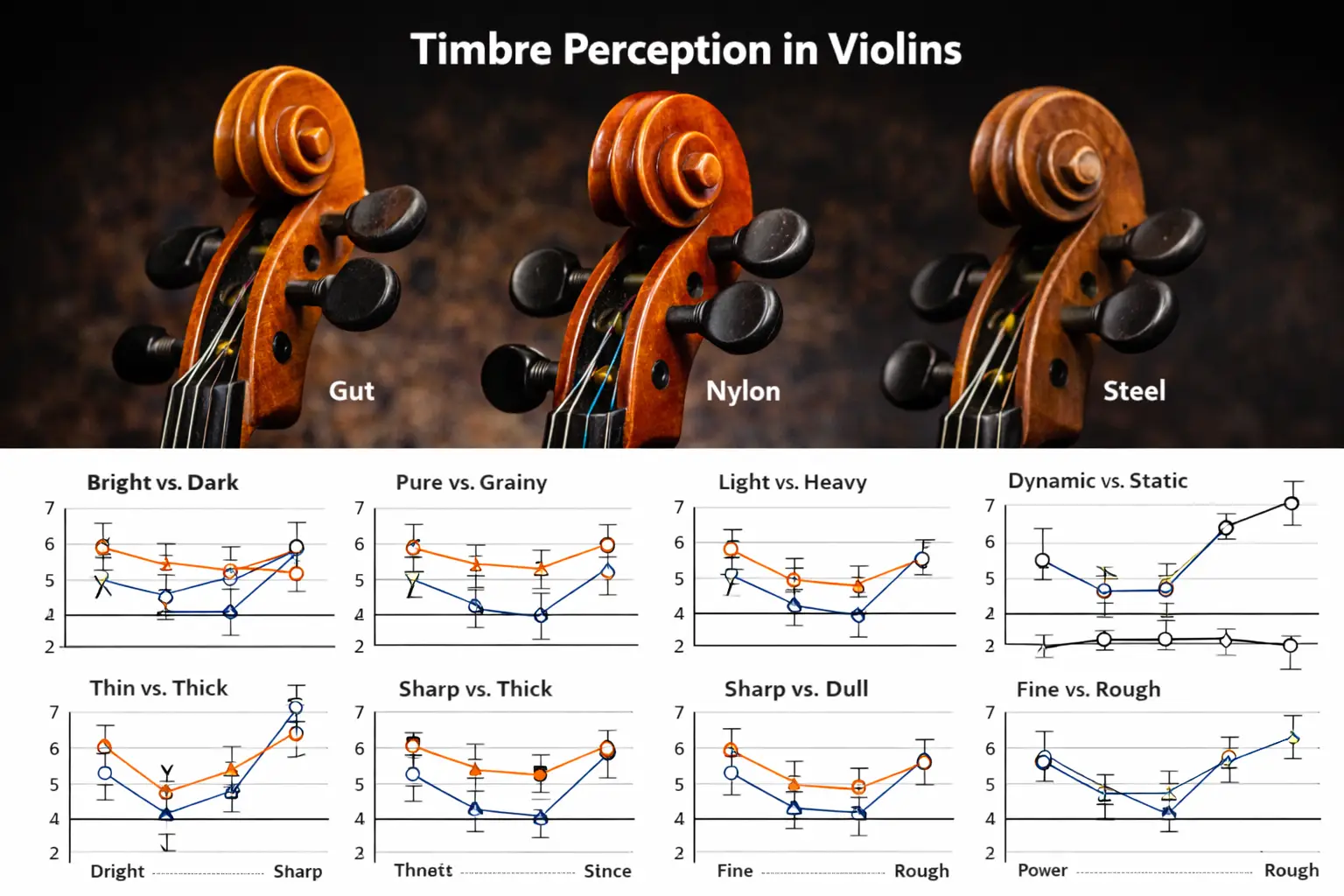
A recent peer-reviewed study published on Nature offers new insight into how violin string materials influence timbre perception, combining controlled listening experiments with advanced statistical and machine-learning analysis. The research examines how gut, nylon, and steel strings affect listeners’ impressions of violin sound, linking subjective evaluations to measurable acoustic features such as spectral energy and formant frequencies.
Profiling timbre through semantic evaluation
Participants evaluated multiple violins fitted with different string materials using semantic differential (SD) scales, rating opposing descriptors such as bright–dark, sharp–dull, and light–heavy. The results reveal that string material significantly alters perceived timbre, though the magnitude of these effects varies depending on the instrument.
For one violin in particular (Instrument A), gut and nylon strings consistently received higher ratings for brightness, purity, lightness, thinness, and sharpness, while steel strings were associated with rougher, heavier, and more dynamic impressions. This contrast suggests that the same instrument can project markedly different sonic identities depending solely on string choice.
Across the remaining instruments, these differences gradually diminished. Some violins exhibited only subtle perceptual variation between string types, indicating that instrument construction can either amplify or suppress string-related timbral characteristics. Steel strings showed relatively stable perceptual profiles across instruments, whereas gut and nylon strings produced greater variability.
Three core perceptual dimensions
To identify the underlying structure of timbre perception, the researchers conducted a factor analysis on the SD ratings. While traditional criteria suggested retaining two dimensions, scree-plot analysis supported a three-factor model, accounting for over 60% of the total variance.
The three perceptual dimensions were labelled:
-
Texture – associated with dark, grainy, and coarse qualities
-
Sharpness – linked to hardness and edge in tone
-
Power – reflecting perceived weight, thickness, and strength
These descriptors align with—but are not identical to—timbre dimensions proposed in earlier psychoacoustic studies, highlighting how adjective-based evaluations capture different cognitive aspects of sound perception compared to similarity-rating methods.
Instrument and string interactions
Statistical analysis confirmed significant main effects of both instrument and string type, as well as strong interaction effects across all three perceptual factors. In practical terms, this means that string choice cannot be evaluated independently of the instrument.
Some violins consistently masked differences between string types, particularly for the Power dimension, while others accentuated contrasts in Texture and Sharpness. Notably, gut strings tended to show the greatest variation across instruments, reinforcing their reputation for sensitivity to setup and construction.
Linking perception to acoustics
The study also explored correlations between subjective ratings and objective acoustic features, including band-limited spectral energy and formant frequencies. While correlations were generally modest, several meaningful patterns emerged:
-
Higher formant frequencies were associated with brighter, sharper, and more vivid texture impressions.
-
Sharpness was influenced by both high-frequency energy and mid-range formants.
-
Power showed weaker and less consistent acoustic correlations, suggesting it may depend more on complex, instrument-specific interactions.
Predicting timbre with machine learning
To move beyond linear correlations, the researchers applied Gradient Boosting Trees (GBT) to model subjective impressions from acoustic data. This nonlinear approach significantly outperformed traditional regression methods, explaining up to 47% of the variance in Texture and Sharpness ratings.
Cross-validation and permutation testing confirmed that these predictions were well above chance, demonstrating that measurable acoustic features encode a substantial portion of perceived timbre, though a large share remains influenced by listener experience, context, and individual perception.
What this means for players and makers
The findings underline a key takeaway for violinists, luthiers, and acousticians alike:
string material matters—but only in dialogue with the instrument itself.
Gut, nylon, and steel strings shape timbre in systematic ways, particularly affecting Texture and Sharpness, yet their perceptual impact depends strongly on how each violin responds acoustically. Power, by contrast, appears less directly tied to simple spectral or formant measures, pointing to a more holistic, nonlinear perception of strength in sound.
By combining psychoacoustics with machine learning, the study offers a refined framework for understanding why certain string–instrument pairings feel immediately “right” to players and listeners—and why others do not.
— The Violin Post Editorial Staff