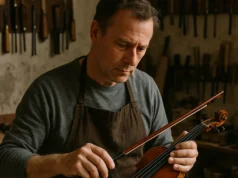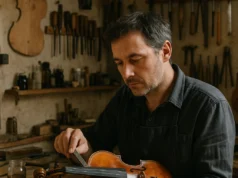







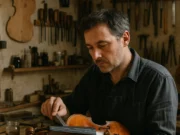




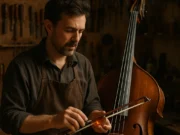























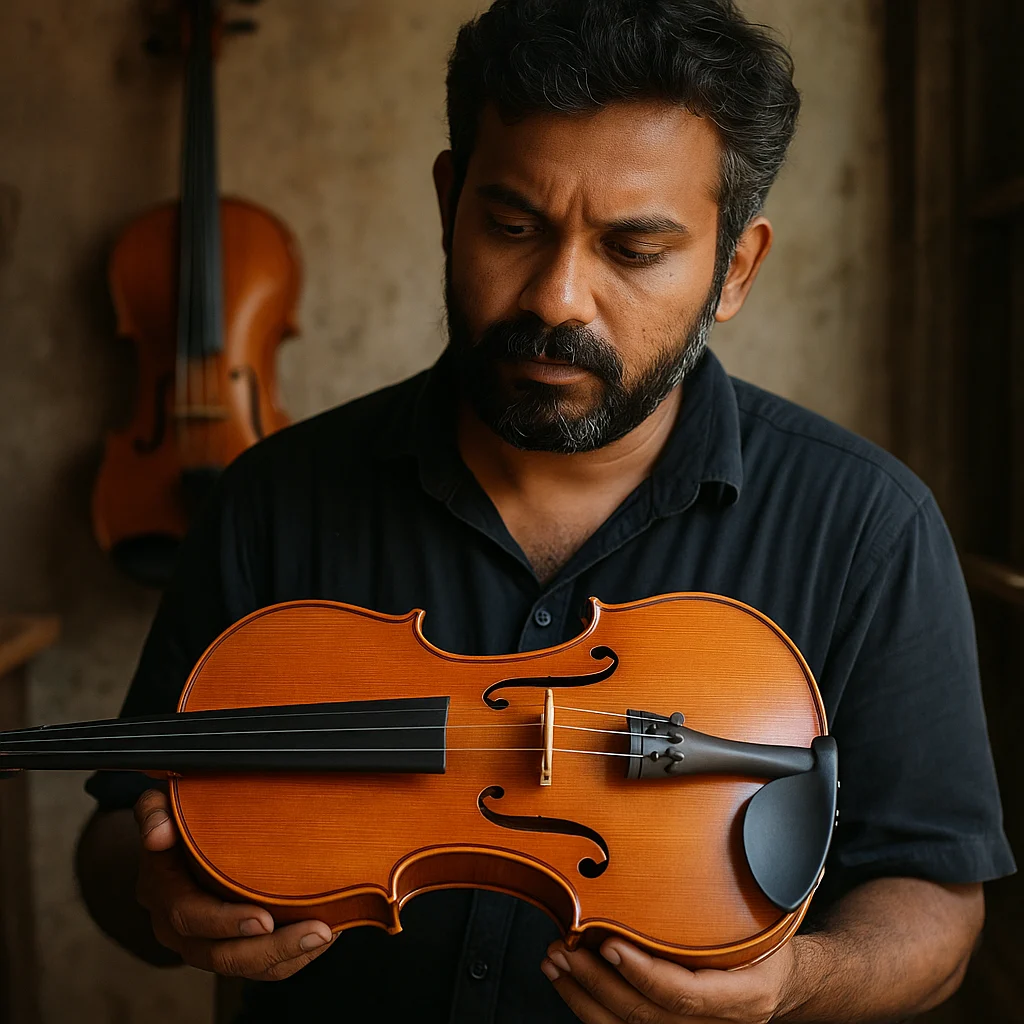
Hidden in the quiet surroundings of Chendamangalam near Kochi in Kerala lies a compact workshop of less than 100 square feet, where vines and tools fill every inch. Along the longest wall, various tools and violins at different stages of production are displayed. The workbench is cluttered with precise measuring devices such as scales and tapes, multiple sizes of brass planers, containers of glue, and posters outlining violin measurements. On the floor rest pieces of wood destined to be transformed into finely crafted violins by Vinay Murali, his father Murali ED, and younger brother Vijay.
Despite the workshop’s modest size, the violins produced here command prices starting at ₹1.5 lakh each. These instruments have attracted musicians from across India, including renowned artists like Kumaresh of the violin duo Ganesh-Kumaresh and Edappally Ajith Kumar. The family employs predominantly natural materials in their production process, using homemade glue and varnish, with the exception of parts like strings and tailpieces, which are sourced externally.
A Journey Rooted in Music and Craftsmanship
The family’s venture into making premium violins began approximately seven years ago, though Murali’s experience with string instruments extends back to the early 1980s. “Back in 1980, a friend and I learned violin and guitar respectively. A pivotal moment came when he handed me his violin to repair, sparking my long-standing relationship with violins,” Murali recounts. Over the years, one violin repair and creation led to another, deepening his expertise.
Music runs in the family. Both Vinay and Vijay have received formal training in violin performance, while Murali, originally trained in guitar at Cochin Arts and Communication (CAC), is also a self-taught violin player. Vinay emphasizes the advantage of musicianship in instrument making: “Understanding how to play the violin is like a mechanic knowing how to drive a car.”
Materials and Techniques: Upholding Tradition and Quality
Initially, Murali crafted violins using affordable local woods, but today the family uses three types of carefully seasoned wood: spruce, alpine maple, and ebony. Spruce and alpine maple are imported from Germany for the soundboard and other components, while ebony, prized for its hardness and durability, is sourced locally and from Sri Lanka for the fingerboard and neck. The ebony’s density makes it prone to wear if used elsewhere.
The wood is aged for at least 15 years through natural drying or controlled kiln drying. Vinay’s carpentry background facilitates a profound understanding of the wood’s nuances essential for crafting high-quality violins.
Learning from Global Masters
A significant milestone came in 2013 when Murali participated in Violin Wise, a workshop series organized by Chennai’s Lalgudi Foundation. The two-week workshop brought Indian luthiers together to learn from James Wimmer, a renowned violin maker from the United States. Murali was one of 14 selected participants, with Wimmer returning almost annually for follow-up workshops, including the latest in 2022. By then, four Indian luthiers had earned the opportunity to learn directly from him, underlining the exclusivity of the program.
These workshops expanded their technical knowledge and provided access to advanced techniques and resources, allowing them to craft violins comparable to those made in Europe. Vinay notes that their instruments reflect the legacy of historic makers like Antonio Stradivari and Giuseppe Guarneri del Gesu. “The principal difference lies in shape — Guarneri violins are more curved, while Stradivari violins have a distinct form. We produce both types, but orders for Stradivarius-shaped violins are more common.” Though their craftsmanship matches European standards, Vinay acknowledges the challenges posed by occasional prejudice.
Customization Tailored to Musicians’ Needs
The family customizes each violin based on the musician’s style. Western classical violinists typically use four-string instruments, whereas Carnatic musicians often prefer five-string violins to accommodate the nuances of their music. Additionally, the neck length is sometimes extended for Carnatic violinists who perform seated on the ground, resting the instrument on their leg to prevent cervical and spinal strain. Murali assures that this ergonomic adjustment does not compromise sound quality.
Weight is another critical factor; their violins typically weigh between 450 and 475 grams for optimal playability and tone.
Time, Craft, and Care in Every Instrument
Violins are made strictly to order, with no fixed production quota. Each instrument requires 250 to 300 hours of meticulous work. Often, the family works on multiple violins simultaneously at various stages of completion.
Adhering to traditional methods, the glue used is natural, derived from animal bones and skin, and the varnish is a homemade formula crafted by Vinay from tree sap cooked in vegetable oil. This natural adhesive maintains the wood’s integrity and makes future repairs feasible. Vinay explains, “Heavy-duty synthetic glues or varnishes harden the wood, hampering repairs. Natural glue holds just enough to secure parts but allows disassembly without damaging the instrument.”
Restoration and Client Relations
Apart from crafting new violins, the family also specializes in restoring historic instruments. Vinay mentions repairing a 1927 German violin with its original label — a rarity, as most violins lack identification and typically survive through three to four generations. They have serviced violins believed to be up to 200 years old, sent from all over India.
Their customer base largely grows through word of mouth due to the exclusivity and high price point of their work. Retail sales are not pursued since these violins are bespoke and crafted in limited quantities. “Our instruments are not mass-produced. Each is carefully custom-made to order,” Vinay states.
For those interested in their work, Vinay maintains an Instagram presence under the handle @fiddle_crafter_luthiers.
Published on April 5, 2023, at 3:34 PM IST
— The Violin Post Editorial Staff