
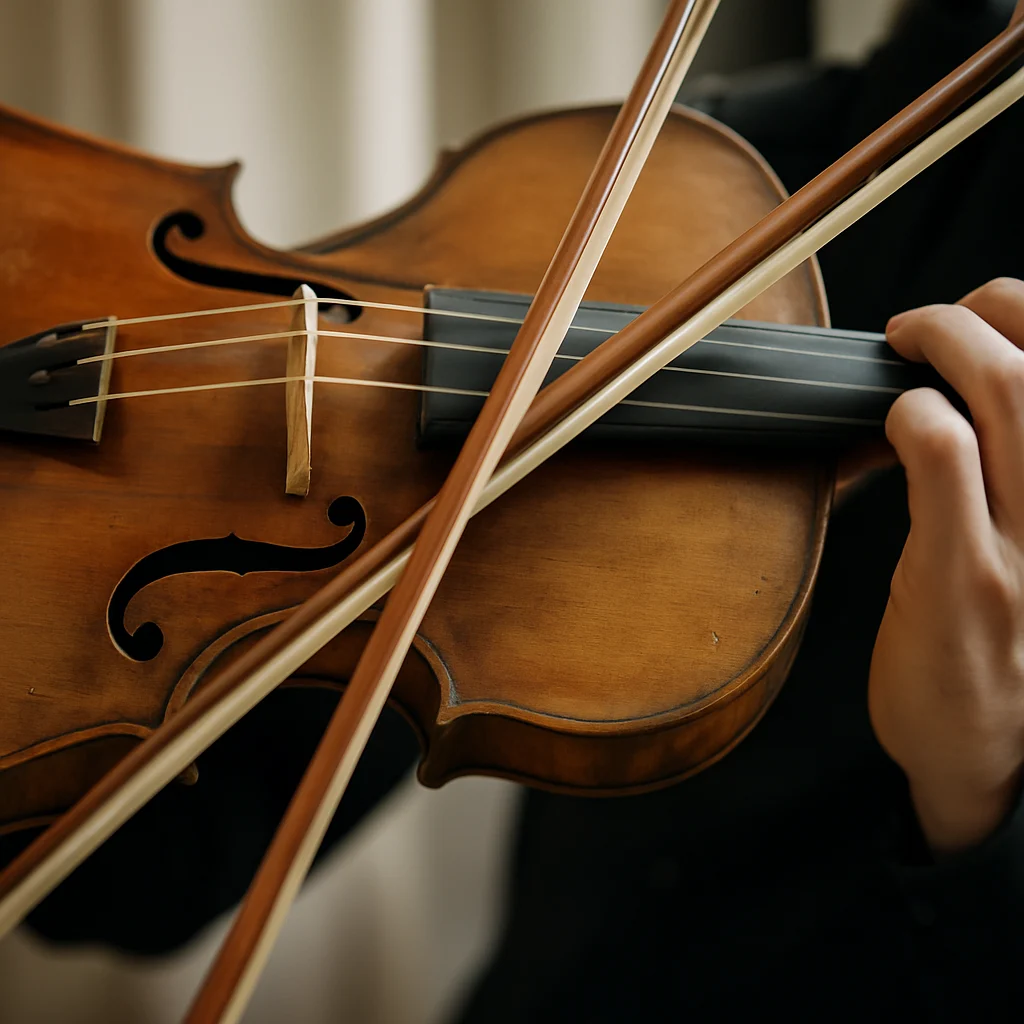
When discussing historically informed performances, the use of gut strings and period bows often evokes associations with Baroque and Classical era music. Extensive research and experimentation have fueled many projects aiming to recreate these works as authentically as possible, reflecting composers’ original intentions.
Why Dudok Quartet Amsterdam Performs Tchaikovsky on Gut Strings and Period Bows – Instruments
Surprisingly, the Dudok Quartet Amsterdam has extended this historically informed approach into the realm of Tchaikovsky — a composer linked with the lush, polished sound of 20th-century steel-string performances. Their latest album features Tchaikovsky’s String Quartet No. 3 along with original arrangements from The Seasons, all performed using gut strings and period bows.
The quartet’s decision to adopt gut strings builds on their ongoing quest to offer fresh perspectives to audiences. Their 2020 debut album of Brahms on gut strings set the stage for this continued exploration. Cellist David Faber explains, “You can hear the naturalness of the material in the sound these strings create — adding a dimension that makes the music feel more flexible, raw, and intense.”
Faber elaborates on the unique decay of sound produced by gut strings: “Early classical recordings featured gut strings exclusively, with players such as Leopold Auer and Fritz Kreisler achieving a rich, sustained tone closer to Tchaikovsky’s own era than today’s modern practices.”
He adds that switching to gut strings demands significant adjustments in right-hand technique to maintain the “singing” quality typical of 19th-century performances. Unlike modern strings that sustain notes for several seconds, gut strings require continuous pressure on each note, allowing highly personal expressive gestures. Consequently, performances of 19th-century music on gut strings will always be uniquely individual.
The right hand’s role is crucial for playing gut strings effectively, but what about vibrato in the left hand? Faber notes that vibrato develops naturally as the player’s sensitivity grows. “As quartet musicians, we already understand that indiscriminate vibrato use can diminish contrasts between consonance and dissonance. Since gut strings have inherent texture, vibrato should only be added for strong expressive reasons, which fortunately Tchaikovsky provides frequently.”
For these recordings, Dudok Quartet Amsterdam selected a collection of instruments spanning European craftsmanship and decades. Violinist Judith van Driel plays a 1725 Francesco Goffriller violin; violist Marie-Louise de Jong performs on a circa 1760 Jean-Baptiste Léfèbvre viola made in Amsterdam; violinist Marleen Wester uses a 1810 Vincenzo Panormo violin from London; and Faber’s cello is a Parisian Jean-Baptiste Vuillaume from 1850, all generously loaned by the Dutch Musical Instrument Foundation (NMF).
Though the ensemble uses gut strings and period bows, their instruments are set up specially: “They don’t have fully modern or baroque setups but instead feature characteristics ideal for 19th-century repertoire,” explains Faber. The Vuillaume and Panormo retain original neck positions, while the other two instruments have 19th-century necks and tailpieces.
This configuration can be described as a hybrid setup. Additionally, to address the frequent tuning challenges of gut strings, three members have installed geared tuning pegs since beginning their gut-string projects in 2020 — a practical adaptation for quartet playing.
Tchaikovsky String Quartets Volume II, featuring this unique approach, is scheduled for release on 28 February 2025 via Rubicon Classics.
— The Violin Post Editorial Staff