


































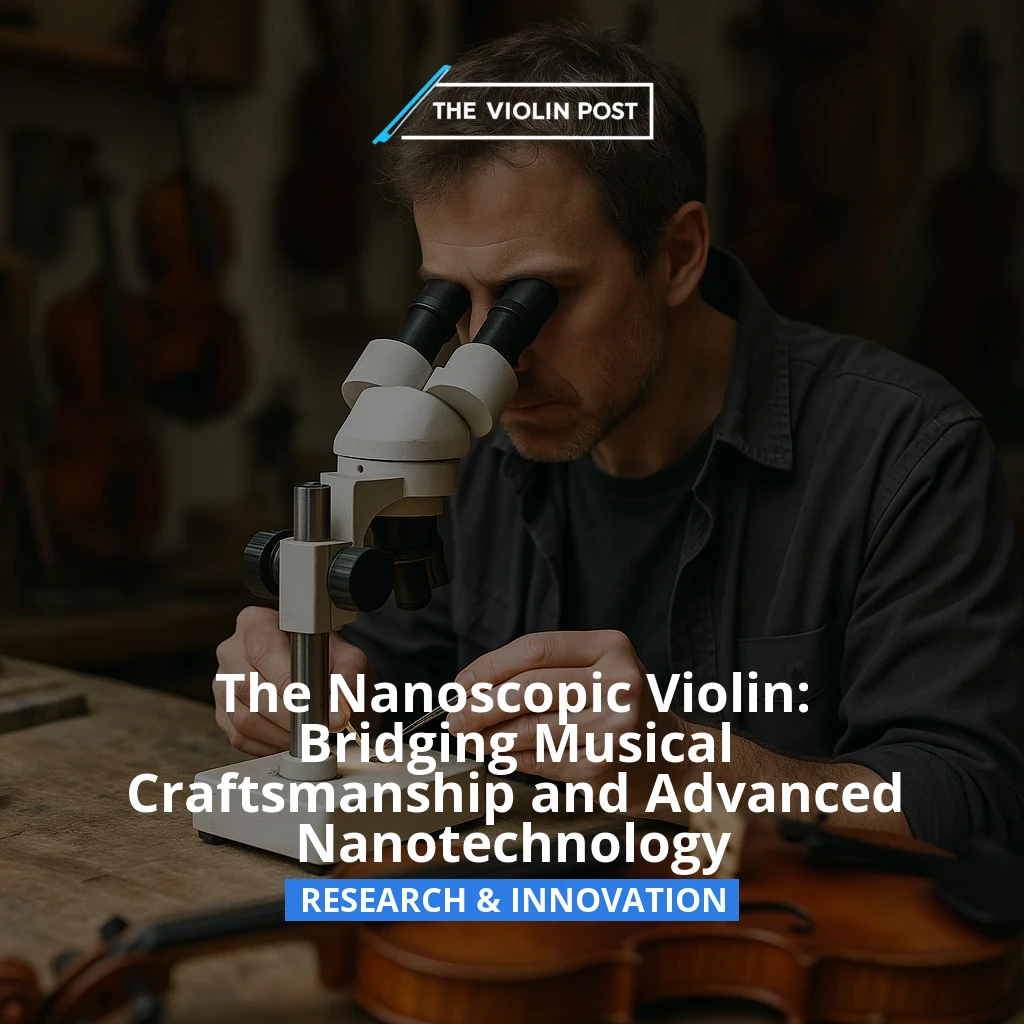
Researchers have successfully created a functional violin at a nanoscale size, marking an unprecedented convergence of traditional musical craftsmanship and advanced nanotechnology. This miniature instrument, described as the world’s smallest violin, is more than a whimsical novelty; it represents a promising step toward harnessing the principles of sound production and resonance at the atomic scale.
The instrument was engineered using sophisticated nanofabrication techniques that allow for precise control over materials and structures at the scale of billionths of a meter. Though diminutive, the violin retains the characteristic shape and functional elements of the traditional instrument, enabling it to vibrate and produce sound waves, albeit in a form and frequency range distinct from full-sized violins.
This breakthrough offers a novel platform to explore how classical acoustic principles operate when applied to nanoscale materials. The tiny violin thus serves as a window into the potential of nanotechnology to manipulate mechanical vibrations and sound with an unparalleled degree of control.
While the practical applications for a nanoscale violin as a musical instrument are limited, its development holds significant implications for multiple scientific and technological fields. For instance, understanding vibrational behavior at this scale could inform the design of ultra-sensitive sensors, nanoscale communication devices, and components for quantum computing systems where mechanical oscillations play a vital role.
Moreover, the intersection of lutherie—the art and craft of stringed instrument making—with cutting-edge nanoscience underscores an interdisciplinary approach to innovation. The adaptation of centuries-old acoustic concepts to the realm of nanomaterials challenges conventional boundaries and opens avenues for future research.
Why this matters
- This advancement demonstrates how classical musical concepts can inform and inspire nanotechnological research.
- Musicians and instrument makers may eventually benefit from insights into material properties and sound production at micro- and nano-scales.
- Luthiers, scientists, and engineers are presented with new possibilities to collaborate on next-generation acoustic devices.
- For students and researchers, the nanoscale violin provides a tangible example of applying physical principles across vastly different scales.
- Institutions focusing on instrument preservation, innovation, and musical acoustics might find relevance in exploring how minute modifications impact sound and durability.
— The Violin Post Editorial Staff